Showing posts with label Google. Show all posts

Wednesday, 21 May 2014

Google is celebrating Marry anning's (British palaeontologist) 215th Birthday


Google is celebrating the 215th anniversary of the birth of British palaeontologist Mary Anning with a special doodle, which shows Anning uncovering a dinosaur's fossilised remains.
Mary Anning, born on 21 May 1799, was a British fossil collector, dealer, and palaeontologist who became known around the world for the discoveries she made while exploring the marine fossil beds at Lyme Regis in Dorset. 
Anning searched for fossils in the area's Blue Lias cliffs – particularly during the winter months when landslides exposed new fossils that had to be collected quickly before they were lost to the sea. It was dangerous work, and she nearly lost her life in 1833 during a landslide. 
Her discoveries included the first ichthyosaur skeleton correctly identified, which she and her brother Joseph found when she was just twelve years old, the first two plesiosaur skeletons ever found, the first pterosaur skeleton located outside Germany, and important fish fossils.
Anning's work contributed to fundamental changes in scientific thinking about prehistoric life and the history of the Earth, at a time when there was little to challenge the biblical interpretation of the story of creation. 

Google is celebrating the 215th anniversary of the birth of British palaeontologist Mary Anning with a special doodle, which shows Anning uncovering a dinosaur's fossilised remains.
Mary Anning, born on 21 May 1799, was a British fossil collector, dealer, and palaeontologist who became known around the world for the discoveries she made while exploring the marine fossil beds at Lyme Regis in Dorset. 
Anning searched for fossils in the area's Blue Lias cliffs – particularly during the winter months when landslides exposed new fossils that had to be collected quickly before they were lost to the sea. It was dangerous work, and she nearly lost her life in 1833 during a landslide. 
Her discoveries included the first ichthyosaur skeleton correctly identified, which she and her brother Joseph found when she was just twelve years old, the first two plesiosaur skeletons ever found, the first pterosaur skeleton located outside Germany, and important fish fossils.
Anning's work contributed to fundamental changes in scientific thinking about prehistoric life and the history of the Earth, at a time when there was little to challenge the biblical interpretation of the story of creation.

Source: Telegraph | image via google

Saturday, 17 May 2014

Apple was SUED the most over Patents in 2013


The patent war of attrition between Apple and Samsung may come across like the singular struggle over tech innovation, but court fights about intellectual property are a regular part of life in the tech industry.
 
Apple was sued 59 times in the U.S. for patent infringement in 2013, the most of any company, according to data from Lex Machina that was charted by Statista. Amazon.com was No. 2, facing 50 suits last year. The data exclude declaratory judgments, which are decisions sought by those looking for court direction in the earlier stages of litigation.

Plaintiffs filed 6,092 patent cases in U.S. courts in 2013, more than doubling over the past five years, Lex Machina said. Trials were held in 128 of the cases. The top 10 of companies facing new U.S. suits is a who’s who of the global tech community, with Google, Dell, Samsung, Microsoft in the list.

Who’s filing all these cases? As you might have guessed, the top 10 filers of new patent suits are “patent monetization entities” — less affectionately known as patent “trolls.” That said, there are several well-known companies among the top 10 plaintiffs asserting patents in open cases, with Apple, Motorola Mobility, Ericsson and Pfizer among them.

[via] | images via WSJ

Wednesday, 7 May 2014

Google Glass costs Google just $80 to make but a Google spokesperson has called teardowm.com finding's “absolutely wrong". WHAT IS THE TRUTH??


The good news for all those people who can't afford $1,500 $1,500 "Explorer headset".

The depressing news comes from Teardown.com (via BetaBeat), who dissemble a pair of google glass and determined the actual price of each of it's component. We were surprised to see how cheap each component was. $1.14 battery clocking,  $5.66 camera and $3 the actual glass used costing $3. The most expensive part was the processor which costs $13.96 approximately.

 A Google spokesperson has called teardowm.com finding's “absolutely wrong" via Wall Street Journal.

Teardown.com does acknowledge that  the cost analysis' calculatios are just estimates. They will conduct some deeper cost analysis. But even if it turns out that there are a few hundred dollars off. This means that Google is taking a huge markup on the Glass.

The question arise is that if the Google Glass costs $80 then why Google is discouraging the general public from buying the head set. 
"Google, add two or three dollars more onto the price, make a nice profit."

Source: Teardown.com (via BetaBeat) | Neowin.net
 image via Google

Tuesday, 29 April 2014

Google's self-driving cars now able to navigate crowded city streets


Google's self-driving cars are getting smarter. After logging nearly 700,000 miles without a driver, the autonomous cars are capable of reacting to a multitude of scenarios unique to city driving. The company released a video which shows one of the cars driving through Mountain View, California, home of Google's global headquarters. The autonomous car was able to safely navigate a parked car protruding into its lane, avoid a biker weaving in and out of the bike lane, and approach railroad crossings with prudent caution.

Google discussed how they tackled the complexity of city driving in a blog post:
As it turns out, what looks chaotic and random on a city street to the human eye is actually fairly predictable to a computer. As we've encountered thousands of different situations, we've built software models of what to expect, from the likely (a car stopping at a red light) to the unlikely (blowing through it).
Despite their cars' excellent track record, Google admits there is still a lot of progress to be made. For example, the variances in city planning mean the Self-Driving Project crew have to teach the cars to navigate each city; they are still working on Mountain View. However, the advances showcased in the video represent massive strides in self-driving car technology.

Source: Google | Image via Google

Monday, 28 April 2014

Google may be fined for not making tax payments to France


Google, one of the biggest names of the Internet, has been outed for not paying taxes to the French government over the past few years after just recently settling in court in regards to a conspiracy lawsuit that lost them $324m. The corporation owes about $1bn to France, and may be hit with an additional penalty as a result, according to Ars Technica.

The company said that they "received a tax assessment from the French tax authorities," and added that “We believe an adequate provision has been made and it is more likely than not that our tax position will be sustained. However, it is reasonably possible that resolution with the French tax authorities could result in an adjustment to our tax position." Google has been put on notice by the French government for not paying their taxes, and has acknowledged that it may be charged a harsh penalty for being non-compliant to the French Direction Générale Des Finances Publiques, which is similar to the IRS in the United States.

TechCrunch has mentioned that Google makes more money in Ireland (€12.4bn), which has a much lower tax rate for corporations (12.5%), compared to France (€138m). While the reasons why the company owes so much in taxes to the French government is no surprise, France is viewing Google as a large corporate entity and is treating it as such. Although Google has been compliant with French law, the government doesn't want the company to undermine them, and get away with passing off contracts as if they were contracts with Ireland in order to get away with paying less in taxes. It seems that recently many governments and corporations are wanting to take Google down a peg.

Source: Le Point via Ars Technica | Image via Gizmodo

Saturday, 26 April 2014

Google, Apple, Intel and Adobe settle conspiracy lawsuit with $324 million payment


Four major Silicon Valley-based tech companies, Google, Apple, Intel and Adobe, have agreed to settle a lawsuit that claimed they tried to hold down the salaries of its workers and restrict hiring employees from each other. As part of the settlement, the four businesses will pay a total of $324 million to the employees who are a part of the lawsuit, which was originally filed nearly three years ago.

At the time, the 64,000 workers who were included as part of the case claimed that Google, Apple, Intel and Adobe, among other companies, had worked together in order to not actively recruit team members from each other. It also claimed that those same companies agreed to put caps on salary offers. The plaintiffs used emails that were written by Apple's late CEO Steve Jobs and former Google CEO Eric Schmidt, where Schmidt told Jobs he would fire a Google recruiter for trying to hire an Apple employee, as evidence of the conspiracy. 

Reuters reports that Google, Apple and Intel would not comment on the settlement. An Adobe spokesperson said the company would not admit to any wrongdoing but added it decided to settle "in order to avoid the uncertainties, cost and distraction of litigation." Three other Silicon Valley companies named in the original lawsuit, Pixar, Lucasfilm and Intuit, had already offered their own settlements.

Source: Reuters | Money gavel image via Shutterstock

Google's mulling Wi-Fi for cities with Google Fiber

Google is considering deploying Wi-Fi networks in towns and cities covered by its Google Fiber high-speed Internet service.
The disclosure is made in a document Google is circulating to 34 cities that are the next candidates to receive Google Fiber in 2015.
Specific details of the Wi-Fi plan are not included in the document, which was seen by IDG News Service, but Google says it will be “discussing our Wi-Fi plans and related requirements with your city as we move forward with your city during this planning process.”
If the plan goes ahead, it would be a further step by Google toward competition with traditional telecom carriers. For citizens of the cities involved, it could mean increased reliance on services by the dominant Internet company.
Google declined to answer specific questions about the plans but in an emailed statement said, “We’d love to be able to bring Wi-Fi access to all of our Fiber cities, but we don’t have any specific plans to announce right now.”
Google Fiber is already available in Provo, Utah, and Kansas City, and is promised soon in Austin, Texas. It delivers a “basic speed” service for no charge, a gigabit-per-second service for $70 per month and a $120 package that includes a bundle of more than 200 TV channels. Installation costs between nothing and $300.
 
Google has sent the 34 cities that are next in line for Google Fiber a detailed request for information and they have until May 1 to reply.
It asks for a list of all the addresses in each city and a description of building types, and requests numerous geospatial data files containing information on streets, boundaries, rights of way, manholes, utility poles, zoning types and the condition of pavement across the city.
Google is also asking cities to identify locations it would be able to install utility huts. Each 12-foot-by-30-foot (3.6-meter-by-9.1-meter) windowless hut needs to allow 24-hour access and be on land Google could lease for about 20 years.
The huts, of which there will be between one and a handful in each city, would house the main networking equipment. From the hut, fiber cables would run along utility poles—or in underground fiber ducts if they exist—and terminate at neighborhood boxes, each serving up to 288 or 587 homes.
The neighborhood boxes are around the same size or smaller than current utility cabinets often found on city streets.
Once each municipality has sent the information to Google, the Mountain View company said it will conduct a detailed study.
“This process will take some time, but we hope to have updates on which cities will get Fiber by the end of the year,” the company says in the document.

11 Qualities Google Looks For In Job Candidates

Google receives between 2.5 and 3.5 million job applications a year.It only hires about 4,000 people.

Senior vice president of People Operations, Laszlo Bock presides over the ultra-selective process.In interviews with The New York Times, the Economist, and students on Google+, the hiring boss sheds light on how the search giant evaluates candidates.
We sifted through those interviews for the most surprising takeaways. Find them below
 
 
  • Google doesn't look for experts
"We would rather hire smart, curious people than people who are deep, deep experts in one area or another," he says, noting that people with strong learning ability can generally find the right answers to unfamiliar questions. "But somebody who's been doing the same thing forever will typically just replicate what they've seen before."
  • Google does want people with high "cognitive ability."
"If you hire someone who is bright, and curious, and can learn, they're more likely to come up with a new solution that the world hasn't seen before," Bock explained in a Google+ Q&A. "This looking for cognitive ability stems from wanting people who are going to reinvent the way their jobs are going to work rather than somebody who's going to come in and do what everybody else does. We recruit for aptitude, for the ability to learn new things and incorporate them."

  • Google seeks out people with "grit."
Bock spoke with The Times about a time he was on a campus talking to a student double-majoring in computer science and math. The student was thinking about switching out of computer science — it was too difficult.

"I told that student they are much better off being a B student in computer science than an A+ student in English," he recalls. Taking computer science "signals a rigor in your thinking and a more challenging course load. That student will be one of our interns this summer."

As breakthrough research in education shows, grit — the ability to keep slogging through difficult work — is more important for success than raw IQ.

  • Google wants to know whether candidates can tackle difficult projects.
The company used to be famous for asking cranium-crashing brainteasers, like "what is the probability of breaking a stick into three pieces and forming a triangle?" But it found they weren't that helpful, and have since moved on.

Now, Google's interviews include questions about the candidate's concrete experiences, starting with queries like "give me an example of a time when you solved an analytically difficult problem."

By asking people to speak of their own experiences, Bock says, you get two kinds of information: "You get to see how they actually interacted in a real-world situation, and the valuable 'meta' information you get about the candidate is a sense of what they consider to be difficult."
  • Google wants candidates with analytical skills
Basic computer science skills will do, Bock says, since they signal "the ability to understand and apply information" and think in a formal, logical, and structured way. But there are options beyond CS. Bock says that taking statistics while he was in business school was "transformative" for his career.

"Analytical training gives you a skill set that differentiates you from most people in the labor market," he says.
  • Google expects people to meet ridiculously high standards.

"We don't compromise our hiring bar, ever," Bock says. Because of this, job listings stay open longer at Google than you'd expect, he says — they have to kiss a lot of frogs before finding The One.
But Google doesn't care about GPAs.

  • GPAs and test scores don't correlate with success at the company.

"Academic environments are artificial environments. People who succeed there are sort of finely trained; they're conditioned to succeed in that environment," Bock says.

While in school, people are trained to give specific answers. "It's much more interesting to solve problems where there isn't an obvious answer," Bock says. "You want people who like figuring out stuff where there is no obvious answer."
  • Google wants to know how much candidates have accomplished compared to their peers.
When Bock was explaining how to write resumes to Thomas Friedman at The Times, he said that most people miss that the formula for writing quality resumes is simple: "I accomplished X, relative to Y, by doing Z."

For example, Bock explained that a lot of people would just write, "I wrote editorials for The New York Times."

But a stand-out resume would be more specific about their accomplishments and how they compared to others. Bock gives a better example: "Had 50 op-eds published compared to average of 6 by most op-ed [writers] as a result of providing deep insight into the following area for three years."
  • Google looks for employees who know when to step up and take a leadership role.
Bock doesn't care for "traditional leadership." Did you take the fast track to becoming president of the chess club or vice president of sales?

"We don't care," he insists. "What we care about is, when faced with a problem and you're a member of a team, do you, at the appropriate time, step in and lead. And just as critically, do you step back and stop leading, do you let someone else? Because what's critical to be an effective leader in this environment is you have to be willing to relinquish power."
  • Google wants to see people who take ownership of projects.
With that sense of ownership, you'll feel responsible for the fate of a project, making you ready to solve any problem. But you also need to defer when other people have better ideas: "Your end goal," explained Bock, "is what can we do together to problem-solve. I've contributed my piece, and then I step back."
  • Google wants to see humility, too.
You need "intellectual humility" to succeed at Google, he says. "Without humility, you are unable to learn." This is a common problem among the well-educated; elite business school grads tend to plateau. Read more

Friday, 25 April 2014

Google may be launching their own wireless cell phone service

In the past Google has shown no fear when trying to expand their business into new markets. After creating and improving Android over the years, as well as bringing their super-fast Google Fiber internet access to select cities, Google may be venturing further into everyday life by launching their very own wireless cell phone service to compete with companies such as AT&T, Sprint, T-Mobile, and Verizon.

Instead of creating their own networks from scratch, Google is said to be buying existing buildings, and towers to become a mobile virtual network operator. This means that they will buy access to networks, and resell it to customers at cheaper rates. The service is expected to initially launch in Google Fiber-enabled cities.

The network will allow its users to send texts, make calls, and browse the web the same as current cell phone providers do. It is also rumored that Google may be using their creation of this network to promote their own Nexus-branded phones. Although it is unlikely that phones from competitors will run on Google's own network, it will be interesting to see how existing providers will fair against Google as the company moves to become a prominent cell phone and internet service provider. 

Source: The Information via Daily Mail


Google looking to offer premium in-store experience with Android Silver


A new Google service appears to be in the works that would introduce customers to a premium Android experience. If this program comes to fruition, it will allow Google to hand pick a set of Android handsets from different OEM's and market them to the public as a premium Android handset.
There have always been strong feelings in regards to the fragmentation issue in the Android ecosystem and while the situation has gotten better, there are still handsets that seem to lose support after a year or two. This program will attempt to unify the experience by creating a strict set of criteria that each "Android Silver" handset would meet. 
According to Android Police, Android Silver requirements would include:
  • Google will choose the top 5 handsets from various OEM's
  • The handset will run the latest version of Android with no or very limited customizations
  • The transition from a standard to Android Silver handset will be seamless with transferring applications, settings, configurations, and data.
  • Offer exclusive services to Android Silver handset owners
Google will also make sure there is a physical presence in retail stores when the program is launched. Similarly, Google currently offers several handsets from a couple of different manufactures on its online store. 

These 'Google Edition' handsets run the latest edition of Android with zero modifications.While the Android Silver program seems to closely align with what Google is currently offering online, there will be a difference with the Android Silver handsets being direct towards carriers. The importance of this program will lay strictly on the customer support, which Google currently cannot provide due to its lack of a physical retail presence.

Source : Android Police | Image via Google

"Ok Google" moves beyond Nexus 5 as Google Now launcher lands on all Nexus and GPe devices


Google launched its Google Now launcher for Android 4.4 KitKat with the Nexus 5 back in Nobember but it didn’t make it available for other KitKat running devices such as the Nexus 4, Nexus 7 and the various Google Play Editions of popular smartphones.

Now, the company has launched the Google Now launcher on the Google Play Store and can be installed immediately on qualifying devices.

The features of the launcher include easy access to Google Now, which is now available at a single swipe on the homescreen. In addition to this, a user can simply say “Ok Google” and initiate a voice input sequence on the device. Apart from the search and discovery features of the launcher, it also provides a slightly revamped notification drawer and homescreen with larger icons and less wasted space. The wallpaper picker is also said to be improved in the Now launcher.

Android users can check out the Google Now launcher in the Play Store here.

Source: Google Play Store | Image via Google

Chrome to support Windows XP until April 2015, one year after Microsoft ends XP support


Microsoft may be less than six months away from cutting off official support for Windows XP, but today Google announced that users of the 12 year old operating system can continue to expect support for running the Chrome web browser for at least one year longer.

In a post on the official Chrome blog, Google said it will extend its Windows XP support of Chrome to April 2015. Currently, Microsoft plans to stop supporting XP on April 8th 2014. In the blog post Google stated:
We recognize that hundreds of millions of users, including a good chunk of current Chrome users, still rely on XP. Moreover, many organizations still run dozens or even hundreds of applications on XP and may have trouble migrating. Our goal is to support Chrome for XP users during this transition process. Most importantly, Chrome on XP will still be automatically updated with the latest security fixes to protect against malware and phishing attacks.
Net Applications' data for September shows that Windows XP is still being used by over 30 percent of all PCs worldwide, although its market share has dropped quite a bit in the last couple of months. Microsoft has said it wants to bring Windows XP down to below 13 percent by the support cut off date.

Source: Google | Image via Softpedia

One week before supports ends, Windows XP still installed on 27.69 percent of PCs


One week from today, on April 8th, Microsoft will release the final public patch for Windows XP, over 12 years after the OS was first launched. However, it looks like XP will still be used by a large fraction of PCs worldwide when support is cut off, according to the latest data from Net Applications.

The firm, which collects unique user stats from its tens of thousands of websites, has posted its March 2014 operating systems numbers. They show Windows XP is being used by 27.69 percent of all PCs worldwide. While that is down compared to February's numbers of 29.53 percent, it still shows that XP is still the second most used operating system in the world, behind Windows 7 at 48.77 percent.

Windows 8 and 8.1 still don't come close to XP's numbers. The updated data from March shows that Windows 8 claims 6.41 percent of the OS market share and 8.1 is still behind at 4.89 percent, despite being released as a free update to Windows 8 users. Combined, Windows 8 and 8.1 claim 11.3 percent of the OS market share, up just slightly from February's 10.68 percent.

However, the focus this month is on Windows XP and the fact that Microsoft will soon cut off support to an OS that many people around the world are still using inside their PCs. While the general public won't get any more XP updates after April 8th, many companies such as banks and even parts of the U.S government will pay big bucks to Microsoft for extended support contracts that will allow them to get updates until they upgrade to a more recent version of Windows.

Even though Microsoft has been warning the public for years about the XP support cut off date, and the dangers in continuing to use the OS beyond April 8th, there are some parties out there, such as the anti-virus company AVAST, who believe Microsoft still needs to keep XP software updates going for a while longer. It won't be long before we know which strategy is the correct one.

Source: Net Applications | Image via Net Applications

Monday, 21 April 2014

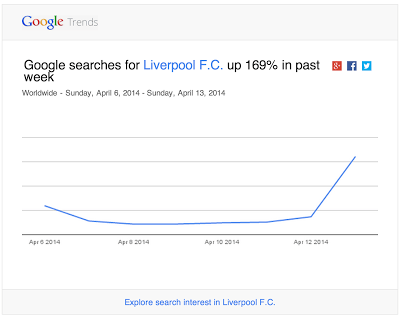
Google Trends Debuts Email Notifications For Search Topics, Hot Searches And More

Google Trends, the informative resource that shows you what’s currently popular around the web right now in and in the recent past, now offers email subscriptions, Google announced this morning. The new feature will allow you to subscribe to any search topic, plus Hot Searches for any country, or any U.S. monthly Top Chart, says Google via a blog post detailing the feature.

However, though Google Trends itself is a real-time data provider, letting you see what people are searching for at this very moment, the subscriptions feature is not always a real-time alerting service. Instead, when you go to create your first subscription for a topic you specify, after selecting the search term and country, you can then set your emails to arrive either “about once a week” or “about once a month.” (The company notes that the “how often” designation is only a rough estimate, and will vary between topics and over time.)

In other words, that feature is designed more for keeping up on news you’re interested in, by allowing you to more passively receive updates on a fairly regular schedule, but not necessarily getting the information the minute it arrives.
However, the “Subscribe” button found elsewhere on the Google Trends website offers more options. For instance, you can subscribe to the “Hot Searches” by either the “Hottest,” “Hotter,” or “Hot” designations, depending on how much you want to keep up with, and you can configure those emails to arrive as-it-happens, once a day or once per week.

Similarly, you can be alerted to whenever a new Top Chart appears for any country or when a chart is updated, also presumably as it happens, though the website doesn’t exactly spell this out.

Google suggests that the emails would make sense for businesses researching their brand, students researching a topic, fans of a sports team, or anyone else looking to track a given topic over time.

You can later manage all your subscriptions from the site’s new “Subscriptions” section, where you can change their frequency, as well as add or remove subscriptions.

The addition could signal changes ahead for a competing service Google offers.

Google has long provided a notification service called Google Alerts for tracking specific Google results, like a breaking news story or competitive intelligence, for example, though it’s been rumored for some time that Google would be shutting this service down. The company quietly killed off Alerts by RSS last year, and the service has since suffered problems where Alerts simply stop functioning correctly.

Now that Google Trends offers the ability to subscribe by search topic, questions about Google Alert’s future are likely to rise again.


Google Acquires Titan Aerospace, The Drone Company Pursued By Facebook


Google has acquired Titan Aerospace, the drone startup that makes high-flying robots which was previously scoped by Facebook as a potential acquisition target (as first reported by TechCrunch), the WSJ reports. The details of the purchase weren’t disclosed, but the deal comes after Facebook disclosed its own purchase of a Titan Aerospace competitor in U.K.-based Ascenta for its globe-spanning Internet plans.

Both Ascenta and Titan Aerospace are in the business of high altitude drones, which cruise nearer the edge of the earth’s atmosphere and provide tech that could be integral to blanketing the globe in cheap, omnipresent Internet connectivity to help bring remote areas online. According to the WSJ, Google will be using Titan Aerospace’s expertise and tech to contribute to Project Loon, the balloon-based remote Internet delivery project it’s currently working on along these lines.

That’s not all the Titan drones can help Google with, however. The company’s robots also take high-quality images in real-time that could help with Maps initiatives, as well as contribute to things like “disaster relief” and addressing “deforestation,” a Google spokesperson tells WSJ. The main goal, however, is likely spreading the potential reach of Google and its network, which is Facebook’s aim, too. When you saturate your market and you’re among the world’s most wealthy companies, you don’t go into maintenance mode; you build new ones.

As for why an exit to Google looked appealing to a company like Titan, Sarah Perez outlines how Titan had sparked early interest from VCs thanks to its massive drones, which were capable of flying at a reported altitude of 65,000 feet for up to three years, but how there was also a lot of risk involved that would’ve made it difficult to find sustained investment while remaining independent.

Google had just recently demonstrated how its Loon prototype balloons could traverse the globe in a remarkably short period of time, but the use of drones could conceivably make a network of Internet-providing automotons even better at globe-trotting, with a higher degree of control and ability to react to changing conditions. Some kind of hybrid system might also be in the pipeline that marries both technologies.
Titan Aerospace also represents just the latest in a string of robotics acquisitions Google has been making lately, which include Boston Dynamics and seven other companies purchased to help fuel its experimental robotics program under Andy Rubin. There’s no question Google has bots on the brain, but thanks to Loon ambitions, the reasoning behind the Titan buy might be the most transparent yet.

Google Launches Chrome Remote Desktop On Android, Allowing Mobile Access To Your PC


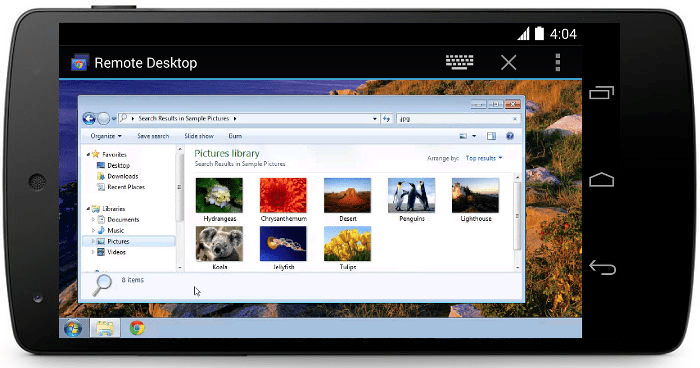
Google this morning launched a mobile client application called “Chrome Remote Desktop app for Android” (whew!) which allows for remote access to your Mac or PC from your Android device, whether smartphone or tablet. The new app is an extension of Google’s previously launched Chrome Remote Desktop screen-sharing service, which allows you to share your desktop’s screen with other Chrome browser or Chromebook users.
 
As with its big-screen counterpart, to use the Android application you first have to install a helper application on your desktop or laptop computer. That app is here in the Chrome Web Store and works on Windows (XP and above), Mac (OS X 10.6 and above) and Linux computers. The helper app installs as an extension to Google Chrome or the Chrome-based OS that powers Google’s Chromebooks.

Once installed, however, you’ll be able to open the app and connect to any of your computers with just a tap, manage them, and navigate through their files and folders from afar — like a modern version of GoToMyPC, for example.
We’ve known an Android client was in the works for some time, as there was even a functional version of the Android client available back in January, though it required that you compile the app from source in order to use it. An iOS version is also in the works, but its development is said to be further behind.

The move comes at a time when competitor Amazon is targeting enterprise users with its own version of remote access software, Amazon Workspaces. Officially launched to the public in March, this service similarly lets company employees access their work computers from any device, including Mac, PC, iPhone, iPad, Android or Kindle Fire HDX tablets. Of course, in Amazon’s case, the goal is to make its tablets appear more business-friendly.

Google’s Remote Desktop, on the other hand, has a more consumer-focused vibe, which even had the company once touting the service as a way to be the family hero by “adjusting printer settings on your mom’s computer to finding a lost file on your dad’s laptop,” for example.
The official Chrome Remote Desktop Android app is available here on Google Play.

Google’s Project Tango Includes Tech Apple-Acquired 3D Imaging Company PrimeSense


If you want a hint of what might be on the horizon at Apple, look to Google – or at least look to its Project Tango experimental 3D depth-sensing smartphone. Tango got a teardown just the other day, and later on iFixit determined that one of its key components comes from what is now an Apple subsidiary (via 9to5Google), thanks to a deal that wrapped up last November.

PrimeSense, which is the company Apple acquired, is responsible for the 3D imaging system-on-a-chip contained within the Tango developer hardware, which is responsible for processing the data gathered by its four cameras and turning that into a 3D map of its surroundings for use by the hardware, system software and developer applications.

iFixit had noted that Tango’s tech worked similarly to early versions of Microsoft’s Kinect sensor for Xbox and Windows, and PrimeSense is actually responsible for having created that tech to begin with. Apple’s uses for PrimeSense aren’t yet known, but some have suggested it could be incorporated into future Apple TV hardware for gesture-based control. The possibility that it might also add Tango-like features to Apple mobile devices is perhaps more tantalizing, however, and this precedent is definitely a promising sign in that direction.

Google Camera App Brings Lens Blur Background Defocus To Any KitKat Android Devices


Google has a new standalone camera app available in the Google Play app store, and it can be installed on any smartphones or tablets running KitKat 4.4 or higher. The new app will also be rolling out to other devices in the future according to Google, so that might expand beyond just KitKat to those on other versions of Android.

The app offers a 100 percent viewfinder to show you exactly what you’re shooting without blocking the view with interface elements, and also offers a few trick modes for taking pictures including Lens Blur, Panorama, and Photo Sphere. Lens Blur offers background defocusing effect like those introduced by most smartphone manufacturers on their latest generation flagship smartphones, so it’s nice to see that kind of stuff democratized.

The Lens Blur feature in practice is kind of tricky to get right, as it required you shifting your phone upwards while remaining centered on your focal point. Samsung’s requires holding your phone in the same place for a while but produces more reliable results in my experience, and HTC’s needs its dual camera hardware in the new HTC One M8 but offers up strangely similar finished products. If used in the right circumstances, Lens Blur works remarkably well at mimicking the kind of depth of field you can capture from DSLRs.

Photo Sphere offers the ability to capture full, 360 degree immersive snapshots and is an extension of the kind of feature you’ll find from Panorama, but not limited to the horizontal plane. It’s the first time Google has made this available to non-Nexus devices, so check it out. I tried installing this on a Galaxy S5 without issue, and it’s a nice alternative if you’re not a fan of or are overwhelmed by the options of the stock offering of whatever device-maker you’ve chosen. Some users on Twitter report having issues getting the app to recognize your phone’s camera hardware, but a quick reboot should do the trick.

Google Patents Tiny Cameras Embedded In Contact Lenses


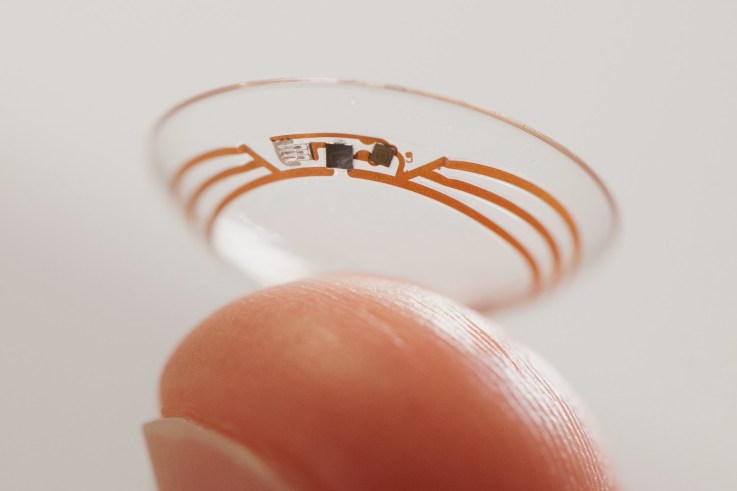
Google has a new patent application with the USPTO (via 9to5Google), which takes one of the basic concepts of Glass and extends it even further, embedding tiny cameras that could be embedded in contact lenses for various uses, including photographing what a wearer sees, or providing the basic input for a contact-based assistive device for the visually impaired.

Google has previously detailed a plan to build smart contacts that measure blood glucose levels in diabetics to provide non-invasive, constant feedback to both a wearer and potentially their doctor, too. This new system describes uses that could also benefit the medical community, like using input from the camera to spot obstacles and alert a wearer who has vision problems as to their whereabouts. They could also offer up vision augmentation for people with all types of ocular health, and even act as a next-gen platform for a Glass-like computing experience.

Obviously, big tech companies patent stuff all the time, and only a fraction of that ever makes it to shipping products. Plus, wearing contacts is something that anyone who doesn’t have to likely won’t warm up to easily. Still, as an assistive device, and an alternative to other, more obvious gadgets and intrusive tech like hearing aids or cochlear implants, this could be a tech that has legs in the near future.

If You Want Google Glass, Now’s Your Chance


It’s been nearly a year since Google released the Google Glass face computer, and still only a select few have had access to the thing. But that’s all about to change.

Right now (perhaps to take your mind off of taxes), Google is opening up a new batch of Google Glass units to explorers, according to an email sent out to those who had signed up for more information on the product.

You must still apply and be selected, so start thinking of why you deserve the opportunity to pay Google for one of their products.

I lied. Google is opening up Glass purchases to anyone who wants to be an Explorer, no application necessary. You will, however, need some cash or plastic to make this thing happen.

As has been the case, this new Google Glass batch carries the same price tag as before: $1,500 + tax. This includes one Glass, a charger, a “pouch”, a mono earbud, and your choice of a shade or frame.

In the email, Google reminds us that this isn’t the same piece of hardware that was shipping a year ago.
“In the past year, we’ve released nine software updates, 42 Glassware apps, iOS support, prescription frames, and more, all largely shaped by feedback from our Explorers,” the email said.

You can purchase Glass here. Now, try not to get beat up.