The Xbox One port of Battlefield 4 may have a resolution of 720p,
but that version of EA's military shooter will have a couple of extra
features that no other will have, thanks to the Xbox One's Kinect
sensor. EA has confirmed that players will be able to use their head in
the game with the additional Kinect support.
What does that mean? Well, according to Polygon,
Battlefield 4 on the Xbox one will allow players to track their head
movements when the Kinect sensor is used. This mean gamers will be able
to lean and peek around corners in the game world just by moving their
heads. The article says this will make a big difference in terms of
gameplay as gamers will be able to expose just part of their virtual
body when they are in corners.
In addition, Battlefield 4 for
the Xbox One will be able to accept voice commands from players, again
thanks to the Kinect hardware. Gamers will be able to request ammo, call
a medic and more with their voice. Battlefield 4 is one of the 21
planned launch games for the Xbox One, which officially goes on sale on
November 22nd.
Microsoft has been known to release special limited edition versions of its Xbox 360 controllers in the past, including one to promote the new Tomb Raider game in 2013 and others that had a chrome colored shine. This week, the company unveiled its latest such product, which has a "cool" art design.
The limited edition wireless controller features an "arctic camouflage" art design,
which makes it look like it's been created for use in winter
conditions. Microsoft's description of the product says, with a straight
face, that's it's been "designed for covert operations". Leaving that rather odd statement behind, it's still a little strange
that Microsoft is launching an "arctic" gamepad for the Xbox 360 when
we are so close to entering the summer months, but maybe it's being
released to give gamers an appearance of being "cool" while playing
games in much warmer temperatures. In any case, the "arctic camouflage" variant of the Xbox 360
controller is otherwise identical to the regular version of the gamepad.
Microsoft will begin selling the controller to the masses later in June
for the price of $54.99, which is $5 more than the regular gamepad. Source: Microsoft | Neowin.net | Image via Google
During the past couple of weeks, Neowin has been looking at the upcoming Surface mini press event
with a bit of suspicion that the 'mini' portion of the event is a bit
of smoke and mirrors to cover up the fact that the entire Surface family
is about to undergo some change. To that degree, we uncovered the specs of the Surface mini and even that we were hearing that Intel would be playing a big part of the event as well.
While Microsoft had previously said that Surface Pro 3 reference that was spotted was 'accidently' posted up on a support page
was a simple mistake, it looks like the Surface Pro 3 just got a lot
more real as pricing and specs of the devices have been uncovered. The folks over at WPcentral appear to have gotten their hands on the
SKUs that will be announced Tuesday as the pricing information is now
being pushed out to retail databases and here is what is known, or at
least presumed to be, the Surface Pro 3 information. For starters, there will be five, yes five, variations of the product that span the entire pricing range:
i3-4GB RAM-64GB - $799
i5-4GB RAM-128GB - $999
i5-8GB RAM-256GB - $1299
i7-8GB RAM-256GB - $1549
i7-8GB RAM-512GB - $1949
There will also be some new covers as well, but this is where the
information is a bit more aloof as we already believe that the Surface
mini will have its own variation for a cover too. Anyways, the new
covers are expected to come in Cyan, Purple, Black and Red; the red
cover could be limited to Microsoft retail outlets.
All of this information falls in scope of what we have been hearing
for some time, that Microsoft wants to create an entire 'family' of
Surface products that span a wide range of prices, as well as
functionality. That 'family' functionality could be determined by its
size, such as the rumored 12in variant of the Surface and the smaller
8in size too. When you bring the current 10in size into the picture, if
all of the above holds true, then Microsoft would have Surface products
at all of the popular tablet and mobile PC sizes.
Microsoft's Surface mini press conference is scheduled for Tuesday
(and we will be there) and based on all of the leaks, it is turning out
to be a product packed event. Source: WPcentral | Neowin.net image via google
The patent war of attrition between Apple
and Samsung may come across like the singular struggle over tech
innovation, but court fights about intellectual property are a regular
part of life in the tech industry. Apple was sued 59 times in the U.S. for patent infringement in 2013,
the most of any company, according to data from Lex Machina that was
charted by Statista. Amazon.com
was No. 2, facing 50 suits last year. The data exclude declaratory
judgments, which are decisions sought by those looking for court
direction in the earlier stages of litigation.
Plaintiffs filed 6,092 patent cases in U.S. courts in 2013, more than
doubling over the past five years, Lex Machina said. Trials were held
in 128 of the cases. The top 10 of companies facing new U.S. suits is a
who’s who of the global tech community, with Google, Dell, Samsung, Microsoft in the list.
Who’s filing all these cases? As you might have guessed, the top 10
filers of new patent suits are “patent monetization entities” — less
affectionately known as patent “trolls.” That said, there are several
well-known companies among the top 10 plaintiffs asserting patents in
open cases, with Apple, Motorola Mobility, Ericsson and Pfizer among them. [via] | images via WSJ
Your Microsoft account
(Windows Live ID) is the combination of an email address
and a password that you use to sign in to services such as Xbox LIVE and
Outlook.com, as well as devices such as Windows Phone and computers
running Windows 8.
A Microsoft account is free and you can use it to:
Purchase apps from the Windows Store
Back up all your data using free cloud storage
Keep all your devices, photos, friends, games, settings, music, up to date and in sync.
5 ways to help protect your Microsoft account
Create a strong password.
Strong passwords use a combination of uppercase and lowercase letters,
numerals, punctuation marks, and symbols. The longer the better, and
don’t use personal information (such as a pet’s name, nickname, or
driver’s license number) that can be easily guessed.
Protect your password.
Don’t use the same password you use on other sites, and remember to
change your Microsoft account password (as well as other passwords)
regularly. Watch out for email social engineering scams designed to
trick you into turning over your password to a cybercriminal.
Enable two-step verification.
Two-step verification uses two ways to verify your identity whenever
you sign in to your Microsoft account. Two-step verification is
optional, but we recommend that you use it. Learn how to turn it on.
Watch out for phishing scams. If you receive an email message about the security of your Microsoft account, it could be a phishing scam. Don’t click links in any messages unless you trust or check with the sender.
“Halo” isn’t simply a perennial game franchise, it’s a part of the Xbox platform itself. In terms of innovation and ideation, it’s sometimes important to people who might not even play “Halo.” And of course it’s a passion and an essential experience for two generations of gamers. So we asked ourselves, how do we begin and where do we go with “Halo” on Xbox One?
In the past, “Halo” games have pushed the Xbox forward, showcasing the console and its ecosystem in entertaining and innovative ways. Making a “Halo” game that runs at 60 frames per second, on dedicated servers, with the scope, features and scale we’ve been dreaming of for more than a decade, is non-trivial. It’s a task that we, at 343 Industries, are taking very seriously to ensure we deliver the “Halo” game that fans deserve, and a game that is built from the ground up for Xbox One.
I’m happy to reveal that “Halo 5: Guardians,” the next installment in the legendary saga of the Master Chief, will launch on Xbox One in fall of 2015. In the tradition of every “Halo” game since its debut in 2001, it is a massive and exciting project.
“Halo 5: Guardians” is a bigger effort than “Halo 4.” That applies to the content and scope of the game, as well as the technology in what’s now a brand new and more powerful engine. Certainly there are some core elements carried over from prior games, but we’ve invested a huge effort in retooling our tech to take full advantage of the Xbox One’s hardware and ecosystem to create worlds and experiences worthy of next-gen.
It’s a game that will hopefully demonstrate the talent, learning and abilities of the 343 Industries team. A game that will incorporate the things we learned from “Halo 4” about technology, aesthetics, performance and scale – and perhaps more importantly, understanding and embracing a community of gamers who love what lies at the heart of this game, and the limitless potential of the “Halo” universe.
And 2015 won’t simply be the year of “Halo 5: Guardians,” it will also be a year that offers us a unique opportunity. The opportunity to invite old friends and new audiences into that universe through the “Halo” television series, launched as a unique collaboration with Steven Spielberg and some of the finest creative minds in the business. A series that will stand alone, as well as complement and enrich the game experience. We’ll have more to share on the “Halo” television series as we near its projected fall 2015 release.
Your Journey Begins in 2014
Many fans noted that I was very deliberate with my phrasing on stage at E3 last year. I spoke about a “journey,” rather than a destination – and that journey definitely begins in 2014 with a giant leap, rather than one small step. We’ll give you much more information about our plans for this year at the Xbox E3 2014 Media Briefing on June 9, and we’re confident that “Halo” fans will be pretty excited about the special plans we have in store.
So until E3, I’d like to express my gratitude to our massive and varied Halo community, whose energy, enthusiasm, criticism and kindness are the driving force behind what we do and what we hope to achieve in “Halo 5: Guardians.”
Microsoft is holding its 18th annual CEO summit this week at its
Redmond, Washington headquarters. However, the company is keeping the
event even more private than it has in the past, and what happens during
the summit is already very secret indeed.
In 2013, Microsoft at least offered a brief summary of what its CEO Steve Ballmer told the 120 attendees of the conference during its keynote address. This year, Microsoft's PR team doesn't even go that far in its brief FAQ about the CEO summit.
In fact, current Microsoft CEO Satya Nadella isn't even mentioned in
the FAQ page. which makes one wonder if he's even bothering to attend.
The official press document does say that other major business
leaders are attending the summit, including Amazon founder Jeff Bezos,
Netflix CEO Reed Hastings and others. Microsoft says the combined annual
sales of the companies that are attending is $3.4 trillion. The event is not open to the public or press and Microsoft isn't even
offering any images or video of the summit. So what's goes on during
the three day conference? Microsoft says the collected business leaders
engage in organized panels and breakout sessions on a variety of
subjects. That's pretty much all the company is saying, as the mystery
surrounding this high powered gathering of business leaders continues.
After many months the latest release
is finally at our doorstep, Microsoft will finally begin the process of
rolling out the much anticipated Windows Phone 8.1 update. The company
will start this lifecycle on the 24th
of June where incremental updates will pop up on our screens for the
next three years. Of course the first couple will include the much discussed UI changes and AI Cortana, with the rest being primarily security and bug patches. We may see some other smaller features like we did with the Data Sense update for Windows Phone 8 last year.
Microsoft states that your network provider and manufacturer have
control over who receives 8.1, and update availability will depend on
your hardware capability and country.
Although some Windows Phone users have already updated to the
developer preview of Windows Phone 8.1, many resisted due to the
implications that were entailed. Installing the preview would void
warranties for many (if not all) network providers, as well as reported
bugs within the operating system when in use. It is also not possible to
rollback the update to the well established 8.0 software, which is
another negative.
There has been a vast array of news on the operating system, including the Project My Screen application that allows your smartphone to be displayed on a TV, monitor or projector. The latest IE11 for Windows Phone, and the highly intuitive Cortana AI will also be made available. In fact if you want to really see what's going on, we recommend you go check out the Windows Phone 8.1 category to hear all the hype.
Microsoft unveiled the first TV and movie projects that it will release and/or develop as part of its Xbox Entertainment Studios division earlier today,
under its Xbox Originals banner. However, the company is already
thinking ahead towards using Microsoft's games IP as source material for
future TV shows.
Polygon reports
that Xbox Entertainment Studios is currently in very early discussions
with the game studios behind titles like Gears of War, Age of Empires,
Fable, Forza and State of Decay to see if they could be developed as TV
projects. Microsoft Entertainment president Nancy Tellem is quoted as
saying:
In the past, for example, when you look at Gears of War, Hollywood
has approached the game studio and they've tried to develop features.
The thing that's great is that we're effectively their in-house arm,
where we're conscious about the brand, about the fans, and we take their
lead as opposed to the other way around.
The company is already working on a Halo live action TV series, with Steven Spielberg as one of its executive producers, along with a separate Halo digital feature
project with Ridley Scott as one of its producers. In fact, Polygon
reports that filming for the Halo feature is scheduled to begin sometime
this week.
The Microsoft .NET Framework 4.5.2 is a highly compatible, in-place
update to the Microsoft .NET Framework 4, Microsoft .NET Framework 4.5
and Microsoft .NET Framework 4.5.1. The offline package can be used in
situations where the web installer cannot be used due to lack of
internet connectivity. The web installer is a small package that
automatically determines and downloads only the components applicable
for a particular platform.
This is an offline installer. There are separate installers for web
and offline installation. If you intend to redistribute either of these
installers in the setup for your own product or application, we
recommend that you choose the web installer because it is smaller and
typically downloads faster. You can download the web installer here.
Wherever possible, Microsoft recommends you use the Web Installer in
lieu of the Offline Package for optimal efficiency and bandwidth
requirements.
The offline package can be used in situations where the web installer
cannot be used due to lack of internet connectivity. This package is
larger than the web installer and does not include the language packs.
You can download and install the language packs from here.
This version of the .NET Framework runs side-by-side with the .NET
Framework 3.5 SP1 and earlier versions, but performs an in-place update
for the .NET Framework 4, .NET Framework 4.5 and .NET Framework 4.5.1.
Supported Operating Systems: Windows 7 Service Pack 1, Windows 8, Windows 8.1, Windows Server 2008
R2 SP1, Windows Server 2008 Service Pack 2, Windows Server 2012,
Windows Server 2012 R2, Windows Vista Service Pack 2. Download: .NET Framework 4.5.2 | 66.8 MB (Freeware)
View: .NET Framework Website | Release Notes
Microsoft’s Surface mini has been a bit of an elusive tablet; having
been rumored for over a year and then not arriving in the fall when many
expected it to show up on retail shelves, we finally have a press event for the new device. We had previously reveled that the device would come with a pen and the tablet is ready to launch but beyond that, the details were a bit slim, until now.
We knew that Microsoft was working to make the device note-taking
friendly but sources are now saying that that OneNote will be baked deep
into the platform. What this means is a bit unclear, but OneNote will
be getting a prominent role with the tablet so look for it to be a focal
point of the device. To build upon this, Paul Thurrott
has his own sources who say that the device will "differentiates from
the mini tablet competition by providing a very accurate and high
quality stylus for note-taking and OneNote integration".
If you were hoping for a kickstand to be built in, we have some bad
news, kinda. The device will have a cover available that will work as a
stand but, like the touch and type covers, will be an available
accessory to the device.
When the Surface 2 launched, it brought with it a new color option,
silver. The mini may expand upon the portfolio of options but we won’t
speculate on the inclusion of color options on the smaller sized
devices.
As previously rumored, the device will be in the 8in class and will
be ARM based, which means that Windows RT will be the OS powering the
goods. Not really a surprise here as Microsoft knows that if they don’t
build RT devices, the OS will go unutilized in the market. But the one thing everyone wants to know is the release date and look
for a June launch but the actual release date is still waffling around a
bit.
One item we are still digging to find out is the launch price, that
is still not known at this point but we would expect Microsoft to keep
it competitive iPad mini which starts at $299 and other tablets, such as
the Dell Venue 8 Pro which starts at around $199 depending on which
retail shop you find it at.
With Mary Jo Foley
accurately hitting a couple of the key Surface mini points on the
recent edition of Windows Weekly and our sources are matching that info
quite closely, this gives us further validation that these bits should
be representative of the final product.
A new report claims Microsoft will begin to sell its Xbox One game console in China sometime in September. If true, this would mark the official launch of a new game console in that country since the government's recent decision to lift the sales ban of such products.
Re/code was the first to report the news, which apparently was backed up by an official Xbox YouTube announcement which has since been put into private mode. The company's corporate vice-president of devices and studios Yusuf Mehdi was quoted in the video as saying:
In China, there are over half a billion gamers, so the opportunity to create globally and locally created content to delight millions and millions of of gaming families everywhere is something that we’re really passionate about.
China had previously banned the sales of all game consoles since 2000, but after a review of the topic in 2013 the government lifted that ban in January 2014. The new law allows consoles to be made in Shanghai and then sold in all of China. However, the government last week also announced it would enforce restrictions on the content of console games sold in China. That would include titles that the government feels would promote "obscenity, drug use, violence or gambling."
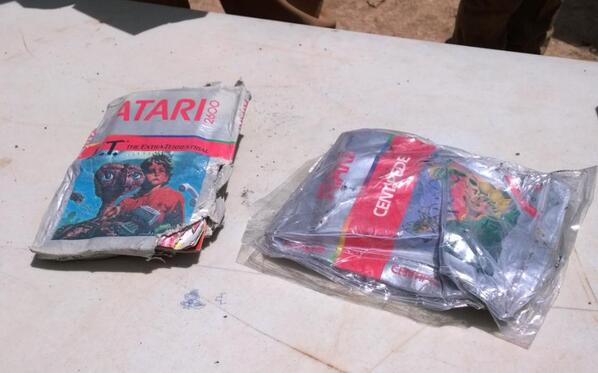
There are tons of urban myths that turn out to be false but today, one
of them can be confirmed as fact. An excavation of a old landfill in
Alamogordo, New Mexico today to see if it really was the place that
millions of Atari 2600 "E.T." game cartridges were buried in 1983 has
proven that is indeed what happened.
The event, which is being filmed as part of an upcoming documentary on both the game and its now infamous fate, is being funded in part by Microsoft. The excavation was open to the public to view and, as reported by IGN, it wasn't long before the digging crews found some copies of "E.T."
In fact, it wasn't just "E.T" Atari games that were found buried in the landfill. Both IGN and Microsoft's Larry "Major Nelson" Hryb
posted images of other cartridges that were found in the pile, some of
them in fairly good condition, considering they have been under tons of
dirt for 30 years. The currently untitled documentary will examine the
burial of all those games as well as the history of the "E.T" title,
which is considered one of the worst games ever made; the film will be
shown exclusively on Xbox One and Xbox 360 consoles later in 2014.
Microsoft's Xbox Entertainment Studios has offered brief teasers about what original TV and film titles it
has planned for its Xbox One and Xbox 360 audience for months. Today,
however, the company officially revealed its lineup of projects
currently in development, which will all be released under the Xbox
Originals banner.
Today's announcement on the Xbox Wire website
says the shows will also be shown on "other Microsoft devices," which
suggests that they will be made available in some way on Windows and
Windows Phone-based products as well. All of the projects will also have
some kind of interactive features.
The first titles will launch this summer. Microsoft has several titles that it says it is "committed" to making, including both a Halo TV series and a Halo digital film project. There's also the "Every Street United" reality series
about urban soccer stars, and the sci-fi series "Humans," which will
debut in 2015. Additionally, Microsoft will offer live concerts from
the Bonnaroo music festival in July. The other project is called "Signal to Noise," a six-film documentary
series that will begin later this year with a project tentatively
titled "Atari: Game Over." This weekend, Microsoft filmed the excavation
of a New Mexico landfill for that documentary to see if Atari really
did bury lots of copies of its "E.T." game for the 2600 console. As it
turned out, that was indeed correct. In addition to the "committed" projects, Xbox Entertainment Studios
has several more in development that may or may not be launched. They
include three drama TV series:
"Deadlands," based on the classic "Weird
West" pen-and paper RPG, "Gun Machine," a hardboiled detective thriller
based on the novel by Warren Ellis, and "Winterworld," a post apocalypse
story based on the comic book from writer Chuck Dixon and artist Jorge
Zaffino. Other projects in development include an untitled comedy variety
series with Sarah Silverman and Michael Cera among the producers, the
stop motion comedy series "Extraordinary Believers" with Robot Chicken's
co-creator Seth Green as an executive producer, and "Fearless," a
reality series that follows the travels of Paul de Gelder, an Australian
Navy bomb clearance diver and shark attack survivor, as he helps other
people who risk their lives in different situations.
Today's announcement did not reveal if Microsoft will charge extra
for viewing Xbox Original programming on its game consoles or if it will
be included in the price of an Xbox Live Gold subscription.
On Saturday, Microsoft, a documentary film crew, and some big excavation machines proved that Atari had indeed buried unsold "E.T." 2600 game cartridges in
a New Mexico landfill during 1983, along with other titles from that
classic console. Now, Microsoft has posted up a brief video clip on
YouTube that shows the highlights from the event in Alamogordo.
The video is hosted by Microsoft's Xbox Live director of programming Larry "Major Nelson" Hryb
and shows the heavy machinery that was brought in to excavate the
landfill. It also features brief chats with many people involved in the
documentary of the Atari "E.T." game including director Zak Penn. The
last part of the video shows the first copies of the game that were
found in the landfill, which confirmed what was previously thought by
many to be just an urban legend.
The final documentary on the "E.T." game saga will be titled Atari:
Game Over and will be shown to Xbox One and Xbox 360 owners later this
year as part of a six series called Signal to Noise; the series is part of Microsoft's Xbox Originals lineup of TV and films that will begin later this summer.
Nearly a year ago, Microsoft announced Bing for Schools,
an effort to give K-12 schools in the U.S. a way to access their search
engine without any ads. Today, after allowing a number of school
systems to try their service out, Microsoft has announced the ad-free
Bing is now available for all K-12 school systems in the United States.
Microsoft has also changed the name of the program to Bing in the Classroom so
that the branding fits better with other education-based efforts from
the company. Before today's announcement, Microsoft let 4.5 million
students in over 5,000 schools in the U.S. access Bing without ads. Now
all a school or school system in the country needs to do is fill out an
online form and their Bing search experience won't have any ads after a
few days.
Microsoft is clearly going after the vast search market share owned
by Google, which is largely supported with ads. Indeed, in a blog post
about the Bing in the Classroom details, Microsoft pretty much called
Google out for their search policies, stating, "At Bing we think
advertising done well is an additive and essential part of the search
experience. But sometimes the best innovation is knowing when to take
something away."
Microsoft is also letting Bing Rewards members who want to use their
points to donate buying a new Surface tablet for their school easier by
letting people search for their preferred school by zip code. They can
also see how many tablets have been donated to their school and how many
Bing Rewards credits have been given towards the purchase of the next
Surface.
Microsoft Research has formed what is being called a "Special Projects
Group" that is being tasked to help create "disruptive technologies that
could benefit the company and society." The new sub-group in the
research division was revealed via new listings on Microsoft's careers
website, along with a new report from ZDNet.
The job listings don't offer up much more information on the Special Project Group, but ZDNet reports
that it's being headed up by Norman Whitaker. He previously was Deputy
Director of the Information Innovation Office at DARPA, which is the
deep science and research division of the U.S. Department of Defense.
The report claims that the new Special Projects Group will work in a
similar fashion as Google X does inside Google, which has worked on
projects such as Google Glass, self driving cars and even space elevators.
So far, Microsoft has not officially commented on the formation of
the new Special Projects Group inside the research division. The company
has recently revealed a number of new projects inside its walls,
including a new 3D display technology called Holograph and a way to add gesture support to keyboards.
Microsoft has been building awesome touchscreen devices for years. A
few fiscal calendars ago, they were called the Surface, but as we all
know, the name Surface has been repurposed and Microsoft now uses the name Perceptive
Pixel to brand its massive touchscreens. While we will put our feelings
aside that we think this is a horrible name for such an awesome
product, the fact is, Perceptive Pixel is a lust worthy gadget and after
being shown an in-depth demo of its capabilities, we are hoping Santa
puts one in our stocking.
When we first heard about Perceptive Pixel touchscreen, we genuinely
thought it was a product looking for a solution. I mean, think about it,
a large touchscreen on a wall, what good is it going to provide
business besides adding more figures to the expenditure column? Well,
when you look at the entire package and especially the functionality
Windows 8.1 brings to the device, Perceptive Pixel becomes product that
is designed for collaboration and left us impressed with the
capabilities of the device. We should note that the Perceptive Pixel is
only a display, a cool one at that, but you do need a laptop, desktop,
or some other machine to put the content on to the device.
How is the Perceptive Pixel different than simply a touchscreen on the
wall? Well, for one thing, it has nearly an unlimited number of touch
points which means that you can have lots of folks using the device at
one time. But more than that, with nearly an unlimited number of touch
points being recognized by the display, when you place your hand on the
screen, it recognizes your hand and its outline instead of a single
touch point.
The device also supports, what we call, a smart stylus input. As you
can see in the image above, the “pres” field recognizes touch
sensitivity. So, with the Perceptive Pixel, it can recognize the
pressure of your inputs that helps you use products like OneNote to draw
thin or thick lines with the stylus. In apps that support the feature,
when you are using the stylus, it stops recognizing input from your hand
which avoids the accidental input by creating smudges on your digital
paper.
But how is the Perceptive Pixel helping business work smarter and not
harder? The device is designed for collaboration, full stop. Sure, it
can be a great display unit but when you have teams working together, on
the same screen, in the same room, the value begins to show.
For example, if you are building a webpage, you can snap the current
page next to a blank sheet of digital drawing paper. On the left, you
show the current design and on the right, you can begin sketching up a
new design in the conference room. For those of you who have done
collaborative web design, you know this process can be a painful task
with one individual sitting on his laptop trying to guess at what you or
the client is saying to make the changes in real time. With the
Perceptive Pixel, you can do this while standing in the front of the
room and with the client on one side, and you on the other, working to
together to sketch out the next steps of the project.
Perceptive Pixel Stylus
It can be hard to understand how a device like this in an office
setting can be of value and even after seeing it, describing how it is
useful can be challenging too. I mean, “it helps people work together on
a single display” sounds unimaginatively boring, until you see it in
action. But once you do see it, it clicks and you see that having an
entire digitized version of meeting minutes and collaborations that are
typically reserved for whiteboards in your inbox, is profound.
The device is large but that’s exactly what it needs to be. It’s
essentially a Surface Pro 2 on steroids and then given a few more energy
drinks. Packed full of sensors and Gorilla glass, it's a device that
you need to see in person, to truly appreciate.
Beyond the fact that the device is 2.5 inches thick and has a 52in
display (80in is also available) and costs over $7000, is the fact that
these units are built by hand in the United States. That's right, hand
built. This is one of the main reasons these units are still expensive
but Microsoft noted that they do expect the price to drop in the future.
These devices are truly unique and it's not until you get in front of
one that the value begins to shine. All we know is that if you get
offered the chance to play with one, don't pass it up, or you will be
missing out on a great piece of hardware.
All those cool 3D holographic interactive user interfaces that people
see in sci-fi movies and TV shows are finally getting closer to
reality. Microsoft Research recently showed off a new project called
Holograph that was made to render large data, not just in 3D, but in a
way that it looks like it is being projected above a display.
In a blog post,
Holograph's team leader Curtis Wong talks about how the project can
help with creating visuals with data that is put inside, for example,
Excel. He states:
That enables anybody with any kind of data, like location or time, to
easily plot that data onto a map or globe. If you select ‘date,’ and
you have date or time information, you’ll be able to watch that data
play out over time.
The fun part of putting all of that data in a 3D projection is shown in the blog post's video, which has Wong using a big Perspective Pixel touchscreen display.
Wong views a version of the Earth above or below the plane of that
display but still manipulate it. The video also shows how data for a
city can be rendered in 3D with graphs and charts created in a view of a
city to better show how those numbers relate to things in the real
world.
The video also has some fun in showing off how Holograph can make the
dreams of sci-fi fans come true, such as one scene where an interactive
Viper fighter in "Battlestar Galactica" is created in 3D. The final
part of the video shows the famous Princess Leia hologram in "Star Wars"
("You're my only hope.') recreated in 3D via Holograph. Perhaps the
whole 3D chess game in that same movie could be the next project for
Microsoft Research.
Microsoft made a rare weekend post on its Security Response Center blog
to announce an advisory that affects all currently supported versions of
Internet Explorer. The issue is based on a newly discovered exploit
that could be used against the web browser.
The blog post states that the exploit "allows remote code execution
if users visit a malicious website with an affected browser. This would
typically occur by an attacker convincing someone to click a link in an
email or instant message." The company is aware of "limited, targeted
attacks" that have used the exploit.
IE 10 and 11 are protected against attacks using this exploit if they
have their Enhanced Protected Mode turned on. Also, PCs that have
either the Enhanced Mitigation Experience Toolkit 4.1 or the EMET 5.0
Technical Preview installed are also secured against this security hole.
Microsoft says that PC owners should always enable their personal
firewall, make sure to have all of the latest software updates for their
programs, and have all the most recent anti-virus and anti-malware
definitions.
Finally, Microsoft said, " ... we encourage everyone to exercise
caution when visiting websites and avoid clicking suspicious links, or
opening email messages from unfamiliar senders." The blog did not have
any information on when Microsoft will release a patch that will close
this latest IE exploit.
The issue affects IE 6, which is still supported by Windows Server
2003 Service Pack 2. It's also still used by Windows XP, which is no
longer supported by Microsoft. That means IE6 users on that OS won't be
getting a patch when Microsoft issues one for the web browser.